Agent UI for Angular · MIT
Ship production agent UIs in Angular.
Signal-native chat, threads, interrupts, tool progress, and generative UI for LangGraph, AG-UI, and A2UI. MIT-licensed, self-hostable, app telemetry off by default, no React rewrite.
Not another backend agent runtime. Keep LangGraph, Genkit, Mastra, CrewAI, or your own service. Cacheplane solves the Angular UI layer.
Works with your agent stack
Bring the model, runtime, and UI protocol you already use.
NGAF gives Angular teams signal-native primitives for LangGraph, AG-UI, chat, and generative UI without locking the backend to one provider.





Why this exists
The fullstack agentic library for Angular.
NGAF brings the pieces of an agentic product into one Angular-first SDK: runtime adapters, signal-native streaming, tool events, generative UI, and production patterns. It is built from real agent UI experience, not a thin integration layer.
Runtime layer
One Angular contract for every agent runtime.
Wire LangGraph, AG-UI, CrewAI, Mastra, Pydantic AI, AWS Strands, or your own backend behind the same Angular primitives.
Streaming state
Messages, status, errors, and tools as signals.
agent() exposes token streams, interrupts, tool progress, branch history, error(), status(), and reload().
Generative UI
Agent output renders into your component system.
Render Vercel json-render and Google A2UI specs into Angular components you already own.
Production surface
The pieces that move a demo into production.
Fallbacks, reloads, persistence patterns, observability hooks, and MIT-licensed primitives you can own long term.
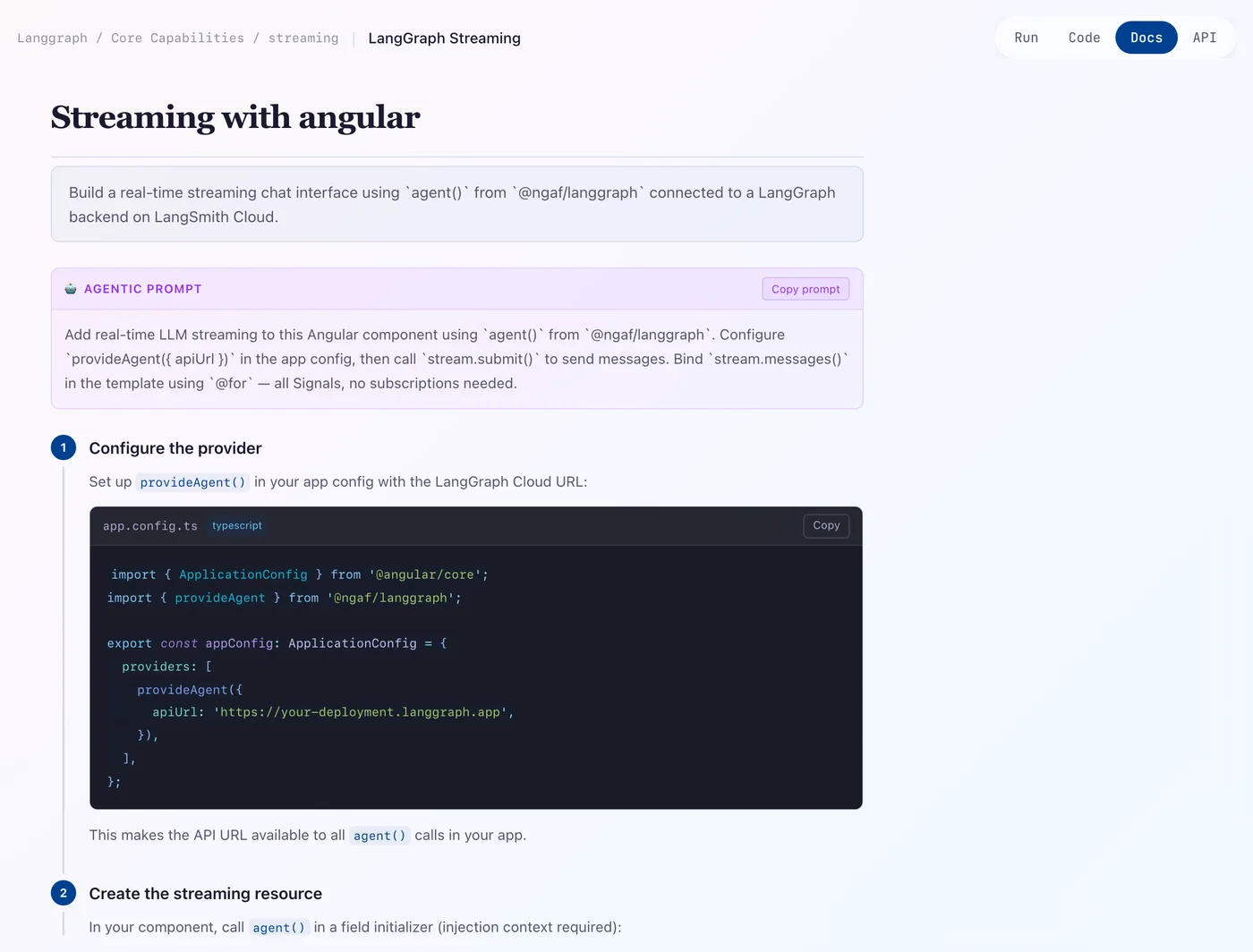
Stream
Stream tokens to Angular signals — no glue code.
provideAgent + agent() give you signals for messages, status, errors, and interrupts. LangGraph and AG-UI adapters share the contract — swap runtimes without rewriting the UI.
- Token-level streaming straight into Angular signals
- Thread state, interrupts, tool progress, branch/history
- Adapters: LangGraph (@ngaf/langgraph), AG-UI (@ngaf/ag-ui)
- One contract, swappable runtimes
Render
Generative UI that renders into your design system.
Server-emitted JSON specs become Angular components you already own. Vercel json-render and Google A2UI both supported, with per-component fallback and a readiness gate.
- Per-component fallback API + readiness gate
- A2UI v0.9-compatible protocol + Vercel json-render adapter
- Renders into your existing component library
- Server-side schema, client-side trust
Ship
Patterns built for production, not demos.
Error boundaries, observability hooks, fallback strategies — the stuff that turns a demo into a real app. MIT-licensed, so the code is yours forever.
- error() / status() / reload() signals
- Readiness gate + per-component fallback
- Thread persistence patterns
- MIT licensed — own it forever
For teams
Ship your first Angular agent in 8 weeks.
Pilot-to-Prod is a concierge delivery — concrete outcomes, your engineers in the driver's seat, no lock-in.
- Working agent demo on your domain
- Hardened production patterns (error/fallback/observability)
- Deploy-ready integration with your CI/CD
- Team trained on the framework + LangGraph
Field report
The last-mile gap in Angular AI.
- Six production-readiness dimensions for Angular AI
- Concrete patterns — error boundaries, fallbacks, observability, deploy
- No vendor pitch. Just what we learned shipping it.
Already on the list? Download the PDF directly.
Built on principles
What we won't do.
Honest commitments, not aspirations.
No closed core
MIT today, MIT tomorrow. Primitives and compositions both stay in the open repo. Pilot-to-Prod is the only paid thing.
No abandoned majors
We support Angular’s current and previous LTS versions.
No required cloud
Self-host LangGraph + your Angular app. Run it all in your VPC.
No app telemetry
We don’t collect prompts, completions, tool data, or app runtime content by default. Package installs send a minimal opt-out ping.
No model lock-in
Adapters work with any LLM your runtime supports. Swap providers without changing Angular code.
Questions
Frequently asked questions.
How is this different from CopilotKit or AG-UI directly?
Does it work with my existing Angular app?
Can I use this without LangGraph?
Is the Pilot-to-Prod program required?
What does it cost?
Is this production-ready today?
Where do I report issues?
I’m using CopilotKit today — how hard is the migration?
Does it work with Angular Universal / SSR?
How do I test agent-driven components?
Stop stalling on agentic Angular.
Install the framework, read the docs, and have a streaming chat in your app this afternoon.
MIT · No signup required · App telemetry off by default